Q.L
photo soon
// Master Candidate · USTB Beijing

Qijun Liao

M.E. in Vehicle Engineering, School of Mechanical Engineering
University of Science and Technology Beijing
Supervisor: Prof. Jue Yang
Deep Reinforcement Learning Control Barrier Functions Physics-Guided Reinforcement Learning Optimal Control Safe Control IsaacLab · MuJoCo PlayGround · ROS2 · CARLA · Carsim · Trucksim · Yolo

About Me

I am a master candidate at USTB (Beijing), supervised by Prof. Jue Yang in the School of Mechanical Engineering. My current research focuses on the theoretical and algorithmic foundations of deep reinforcement learning and control barrier functions, with a particular interest in how physics-based structure can be incorporated into policy design to improve both safety and sample efficiency. Concretely, I have developed methods for probabilistic safety constraints via CVaR-based CBF reformulation, energy-grounded reward shaping with formal convergence guarantees, and geometry-aware action parameterization that enforces hard actuator limits within the policy itself. All works are validated on simulation platforms including MuJoCo, Isaac Lab, and TruckSim.
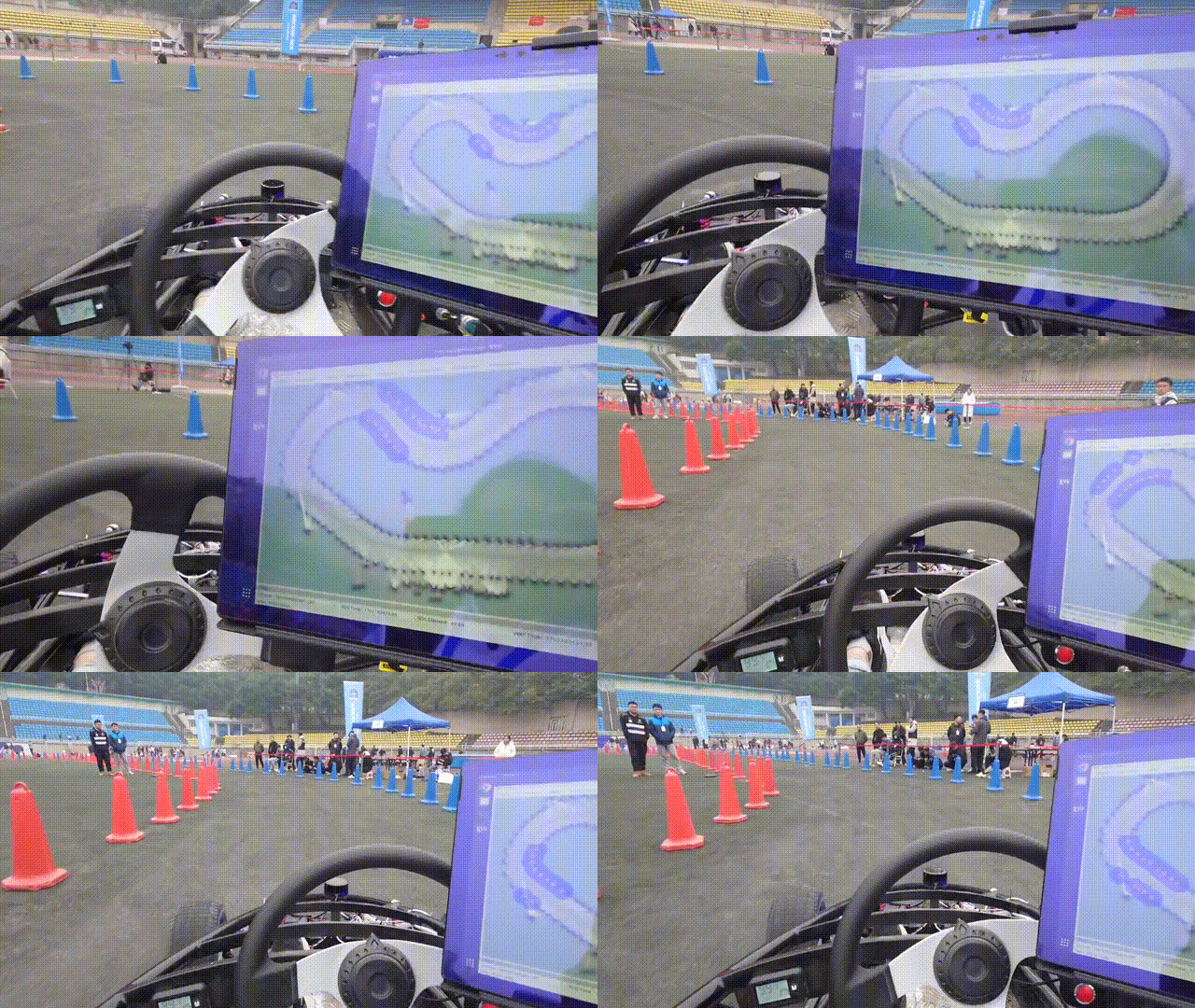
Research Demo

News

Mar 2026
Completed H-EARS major revision. Resubmitted to Neurocomputing.
Mar 2026
Assigned task in Digital Intelligence Group at BAIC BJEV: leading integration of an LLM-based assistant into internal engineering office software.
Jan 2026
Started DD-SRad: a plug-and-play decoupled action-rate constraint module for policy optimization in RL. Breaks dimensional coupling in global-radius squashing methods.
Jan 2026
Completed R²CBF: response-aware risk-constrained control barrier functions for vehicle safety. Submitted to Automatica.
Jan 2026
Completed H-EARS: physics-guided reward shaping via hybrid energy decomposition. Framework with functional independence proof. Submitted to Neurocomputing.
Nov 2025
Started R²CBF: To address the issue of overly complex vehicle modeling and the reliance of safety control on the estimation of environmental parameters, proposed a control barrier function control framework based solely on simplified nominal models and vehicle body responses.
Sep 2025
Joined BAIC BJEV (Beijing Electric Vehicle) as Supply Quality Engineer Intern in the Chassis Engineering Department.
Jul 2025
Completed Wheel Load Estimation project. Proved Pressure-Velocity Uniqueness Mapping Theorem under fluid-inertia dynamics with application to hydra-pneumatic suspension. Submitted to Vehicle System Dynamics.
Jun 2025
Started H-EARS: To enhance the effectiveness and convergence efficiency of reinforcement learning algorithms, proposed a lightweight reward shaping framework combining Lyapunov stability theory and simplified hybrid energy modeling of the system.
Jan 2025
Started Wheel Load Estimation: Focusing on the difficulties in estimating the vertical force of heavy unmanned vehicles' tires, based on the physical modeling of the structure and output force characteristics of the oil-gas suspension, established a real-time estimation framework for the vertical force of tires.
Sep 2024
Began M.E. studies at USTB, School of Mechanical Engineering, supervised by Prof. Jue Yang.
Jul 2023
Joined SAIC-GM-Wuling (SGMW) as R&D intern in the Prototype Testing Department, Liuzhou. Worked on DHT topology analysis and energy management strategies.

Publications

R²CBF
Automatica 2026
Response-Aware Risk-Constrained Control Barrier Function With Application to Vehicles
Qijun Liao*, Jue Yang  * Corresponding Author
Automatica, 2026
We present R²CBF, a distributionally robust Control Barrier Function that integrates hybrid response-aware uncertainty modeling with CVaR tail-risk reformulation and achieved considerable results in the multi-objective stability control task of multi-axis vehicles.
H-EARS
Neurocomputing 2026
Hybrid Energy-Aware Reward Shaping: A Unified Lightweight Physics-Guided Methodology for Policy Optimization
Qijun Liao, Jue Yang*, Yiting Kang, Xinxin Zhao, Yong Zhang, Mingan Zhao
Neurocomputing, 2026
We introduces a dual-layer physics-guided reward shaping framework built on a functional independence theorem: task and energy objectives are proved to be independently optimizable without gradient interference, resolving a fundamental conflict in prior unified potential designs.
VSD
Veh. Syst. Dyn. 2026
Wheel Dynamic Load Estimation Method Based on Gas Pressure of Hydro-pneumatic Suspension
Qijun Liao, Jue Yang*, Subhash Rakheja, Yiting Kang, Yumeng Yao, Yuming Yin
Vehicle System Dynamics, 2026
We propose a single gas pressure sensor approach for wheel dynamic load reconstruction, eliminating the need for force transducers.

Research Projects

DD-SRad
Decoupled Dynamic Spherical Radial Squashing
Oct 2025 – Present  ·  In Preparation
Goal
Drop-in RL module that enforces per-joint actuator slew-rate limits without post-hoc clipping or hierarchical filtering.
Platform
Isaac Lab — Unitree GO2 and Unitree H1 in rough terrain, Unitree G1 and SPOT in flat terrain, heterogeneous joint actuator limits
Key Result
Hard constraint satisfaction with probability 1 for all dimensions simultaneously and considerable performance; compatible with SAC and TD3 off-policy pipelines.
Isaac LabPyTorchSACTD3
R²CBF
Response-Aware Risk-Constrained CBF
Sep 2025 – Jan 2026  ·  Automatica
Goal
Safety-critical vehicle control under uncertain friction without real-time parameter identification.
Platform
TruckSim six-wheel mining truck, MATLAB/Simulink co-simulation
Key Result
Rather than relying on conservative L∞ worst-case bounds, safety is enforced over the tail distribution of the CBF derivative, driven by measurable body signals that map model-environment mismatch to response distribution variance. Online covariance adaptation via Bayesian Inverse Wishart conjugate updates enables continuous safety margin adjustment without real-time friction identification. Experiments confirm zero safety boundary violations across all extreme combined-condition scenarios, with per-step violation probability empirically matching the theoretical bound of βrisk = 0.05.
MATLAB/SimulinkTruckSimSOCPCVaR
H-EARS
Hybrid Energy-Aware Reward Shaping
Jun 2025 – Jan 2026  ·  Neurocomputing
Goal
Plug-and-play reward shaping that accelerates RL training via mechanical energy structure, without environment-specific tuning.
Platform
MuJoCo (Ant, Hopper, Humanoid, LunarLander), TruckSim vehicle simulation
Key Result
Energy-based potentials are shown to provide informationally richer guidance than sparse task rewards, with convergence acceleration factors proportional to energy gradient magnitude over task reward sparsity. An O(n) selective dynamics capture strategy reduces modeling effort from expert-level analytical mechanics to energy-based characterization. Validated on Ant-v5, Hopper-v5, Humanoid-v5, LunarLander-v3, and TruckSim vehicle simulation.
PyTorchMuJoCoTruckSim
Suspension Est.
Wheel Load Estimation via Gas Pressure
Jan 2025 – Jul 2025  ·  Vehicle System Dynamics
Goal
Replace multi-sensor wheel load measurement with a single gas pressure sensor for cost-effective real-time estimation.
Platform
Hydro-pneumatic suspension bench test rig, TruckSim co-simulation (ISO-8608 Class C/D)
Key Result
A nonlinear model explicitly accounts for fluid inertia in gas-oil coupling, where fluid acceleration terms dominate hysteresis at high-frequency excitation (3–8 Hz). The Pressure-Velocity Uniqueness Mapping Theorem proves bijectivity and differentiability of p → v → Fz under these dynamics, guaranteeing unique load reconstruction from pressure trajectories alone. Bench tests (3–8 Hz sinusoidal): force RMSE <4.2%, velocity RMSE <3.8%. TruckSim co-simulation on ISO-8608 Class C/D roads: wheel load RMSE <5% across braking, cornering, and combined maneuvers.
MATLAB/SimulinkTruckSimState Estimation

Education

Sep 2024
— Present
M.E. in Vehicle Engineering
University of Science and Technology Beijing (USTB)
GPA 88.1 / 100  ·  Top 20% in Major
Second-Class Graduate Scholarship (2025) Merit Graduate Student (2025)
Sep 2020
— Jun 2024
B.E. in Vehicle Engineering
University of Science and Technology Beijing (USTB)
GPA 87.1 / 100  ·  Top 20%  ·  Admitted to M.E. without entrance exam
People's Scholarship (2022, 2023) Merit Student (2022, 2023) Outstanding Graduates (2024)

Honors & Awards

Competitions
National · 3rd Prize
14th National Zhou Peiyuan Mechanics Competition  (Highest award ever achieved by USTB in this competition)
May 2023
National · 2nd Prize
18th National University Smart Car Competition — National Finals (Outdoor Driving Challenge)
Dec 2023
National · 2nd Prize
18th National University Smart Car Competition — Northern Division (Outdoor Driving Challenge)
Dec 2023
Provincial · 2nd Prize
National University Physics Competition (Partial Regions)  (Ranked 1st among all students in School of Mechanical Engineering)
Dec 2021
University · 1st Prize
USTB Robotics Competition 2021
May 2021
University · 3rd Prize
USTB Physics Competition 2021
Oct 2021
Scholarships & Academic Titles
Graduate · 2nd Class
USTB Graduate Scholarship
Aug 2025
Graduate
USTB Merit Graduate Student
Oct 2025
Undergraduate
Merit Student
Oct 2023
Undergraduate · 3rd Class
People's Scholarship
Nov 2023
Undergraduate
Merit Student
Oct 2022
Undergraduate · 3rd Class
People's Scholarship
Oct 2022

Experience

BAIC BJEV
Beijing Electric Vehicle
Sep 2025 — Present
Beijing, China
Supply Quality Engineer Intern
Chassis Engineering Department
  • Responsible for quality assurance of critical chassis sub-systems including steering, braking, and suspension; analyzed manufacturing deviation impacts on vehicle handling performance and NVH characteristics.
  • Developed supplier audit protocols and tracked component deviation metrics across production batches, providing data-backed feedback to upstream suppliers.
  • Gained hands-on insight into sensor noise sources and mechanical friction nonlinearities in production-level chassis hardware — directly informing modeling assumptions in my research on CBF-based safety control.
  • Currently leading the integration of an LLM-based assistant into the department's internal engineering office platform. The system is designed to support chassis quality documentation workflows, including automated report drafting, defect pattern summarization, and specification retrieval — reducing manual overhead in day-to-day QA processes.
SAIC-GM-Wuling
SGMW Automobile
Jul 2023 — Aug 2023
Liuzhou, China
R&D Intern
Prototype Testing Department
  • Analyzed DHT (Dedicated Hybrid Transmission) topology architectures and energy management control strategies; produced a 100+ page technical report on system architecture covering mode switching logic, power flow optimization, and thermal management integration.
  • Participated in prototype vehicle assembly and functional debugging, bridging theoretical powertrain design with manufacturing constraints and physical system behavior.
  • Developed practical familiarity with hybrid drivetrain test procedures, instrument calibration, and data acquisition pipelines used in pre-production validation.

Contact

Feel free to reach out via email or find my work on arXiv and GitHub.